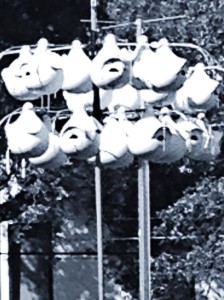
Purple martins – a kind of large swallow – arrive in Texas every spring, find a backyard birdhouse to adopt, lay a little clutch of eggs, and leave by late summer. They’re nomadic but predictable. They’re noisy but pretty. And they eat mosquitos and other buzzy stingy things. What’s not to love?
Condominiums
Crowded with young families
Hatching future plans
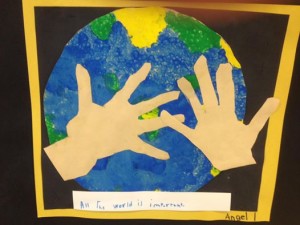
Aaahhh, the most amazing art greeted me at my school visit today.
I love when teachers encourage students to respond creatively to books — it validates and values art, it feeds the great energetic cycle of inspired and inspiring, and it’s just plain pretty.
Things can be done with
tempra paint and little hands.
Yes. Important things.
I am lucky enough to be able to do work that I love — writing books for kids and visiting with kids and talking to other writers about writing books for kids. And today is my birthday, which I think is a good day to take account of all that lucky goodness.
So please understand that my haiku (which is sort of a whiny complaint) is totally tongue in cheek. 🙂 I’m flattered to sign books, and thrilled that so many kids will have them in their hands tomorrow.
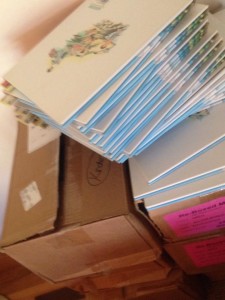
Signing stacks of books
for tomorrow’s school visit.
Send electrolytes.
Sometimes I like to use these posts to talk about poetry, or haiku in particular, or something going in the my life. And sometimes there’s just nothing more to say.
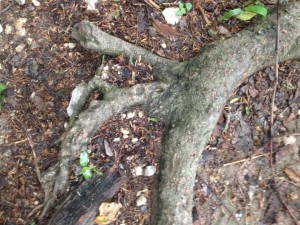
Tree stands on thick toes
desperately gripping earth
like the rest of us
So why a haiku every day in April, as opposed to a sonnet or sestina or something?
Well, the obvious answer is that they’re short and quick, right?
But. Only kind of.
The thing I love about haiku is that they’re short, but deep. They are about pausing purposefully, noticing mindfully, taking a full breath and being totally present to a moment. In that way, writing a haiku every day for a month becomes a truly meditative practice. There is so much more going on in each poem than 17 syllables.
Fireworks, birthdays
There is no greater joy than
a dog off his leash
It’s that time of year again.
April. Bright buds and birthdays.
Chilly mornings and warm afternoons.
Pollen. Poetry.
April is National Poetry Month and this year for the (I think) 8th year in a row, I’ll be writing and sharing a haiku each day. Last year, a whole slew of friends joined me in the practice which just made the whole thing more ecstatic. You’re welcome to join in this year….
And now, without further ado….
If the question is
“Travel by land or by sea?”
This scull answers that
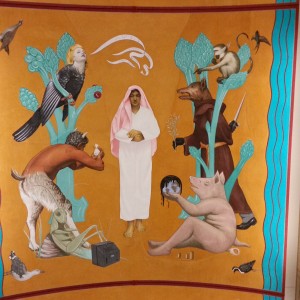
It’s a month of ekphrastic poems for my poetry sisters and me — and wow, what art, huh? Laura Purdie Salas found it at the University of St. Thomas in Minneapolis — it’s part of a ceiling fresco and she thought (rightly) that it might serve to inspire us.
My poem emerged as a villanelle. Enjoy. Or take in. Do with it what you may…
Hark!
By Liz Garton Scanlon
Hark, who’s that knocking, who comes to call?
The fallen and slothful, you vain and you meek –
you’re welcome here, truly, there’s room for you all.
You come bearing gifts, some spiteful, some small.
Horned heroes bow humbly, the devious speak –
hark, who’s that knocking and who comes to call?
Now hush — a suggestion – that we raise a wall
to keep us from outsiders evil or weak:
You’re unwelcome here now; there’s no room for you all.
There’s enough here already, there’s rancor and sprawl!
The masses, all sure of their fervent critique,
call out Hark, who is knocking, oh who comes to call?
The harpy sings shrilly, beasts hide in god’s shawl
and the picture they paint is horrific and bleak.
Are we still welcomed truly, is there room for us all?
What started as discourse has descended to brawl
and we’ve traded on everything right and unique.
Hark, now, who’s knocking and who comes to call?
You’re welcome here, truly, there’s room for you all.
Sedoka is a Japanese form that consists of 6 lines of 5-7-7-5-7-7 syllables respectively. Each 5-7-7 unit is called a katauta. Traditionally, the second katauta says the same thing as the first katauta, although in a different way.
I wrote a whole series of sort of domestic ones, about cooking and minivans and dishwashers but in the end I decided to share this one, a poem in two voices.
It’s sort of my flipped version of that old Gary Larson Farside cartoon about what we say and what the dog hears:
Woman and Dog Sedoka
By Liz Garton Scanlon
The dog follows me
every time I switch places.
It’s how he shows he loves me.
Why can’t she sit still?
I should keep an eye on her
but oh, to nap in the sun!
This past fall I was in New York with my writer pal Audrey Vernick and we stumbled upon this Picasso Exhibit at MOMA. We really did. We had a couple of hours to kill in Manhattan, and lo and behold, this. The whole experience blew us away. The breadth, the quantity. The fact that Picasso was apparently good at everything in every medium.
So when it was my turn to offer up an image to my poetry group for ekphrastic inspiration, I thought, YES — Picasso! In the end, I shared multiple images so everyone could find one that spoke to them. Here’s mine!
Picasso’s Woman
Liz Garton Scanlon
When you look in the mirror
and see a body
that isn’t yours – hips
like an egg timer
with all the sand stuck
in place, thighs the size
of a small state – they say
that’s a disorder, a delusion,
which is a way of saying: Look, there’s something else
wrong with you, not just the
thick neck and uneven breasts,
but also this – this way
of thinking – you’re disordered!
and because you always listen
to all of the voices
you hurry to have your head
shrunk
right away.
What a year. Really, we had such a great year — my friends Sara, Laura, Tricia, Andi, Tanita, Kelly and I — writing poetry together, a new form each month. A new form that we invariably thought would be easier than it ended up being. But still, somehow, a pleasure.
So, the grand finale? A Crown Sonnet. Seven linked sonnets, each one beginning with the last line of the previous one and the final one wrapping up with the very first line from the first sonnet. And because we like a challenge, we thought, “Hey, let’s make them all about the periodic table of the elements. We each get a row.”
ANYWAY, you guys, here’s mine. It’s a lowly little sonnet — the fifth in a series of seven. Read it, but then go over to Tricia’s and read the whole thing. It’s kind of awesome. If I do say so. Enjoy.
Sonnet V
It’s odd to think it’s metal, and not stone
that we bite down on, gnash and grind at night.
Fine silver mixed with tin, its pauper clone,
alloyed with other charms to fend off blight.
The way these chemicals transist, set in —
you’d never know they weren’t a part of us.
Perhaps they are as native as our sins
the framework for our aches, the messy truss.
Rubidium — are we made up of you?
And cadmium and antimony too?
Unstable ores that blow the earth askew
so there’s no fault, no consequence undue.
But what if we own up, apologize:
Don’t blame the elements for our demise.