Yesterday I had a conversation with a friend about how much alone time we need. In a nutshell: More than other people need. Or at least that’s how it seems.
That’s not to say I don’t love people unspeakably much! I think that’s one of the things I love about poetry — and literature of all kinds. It allows us to connect so deeply while also giving us space. What magic!
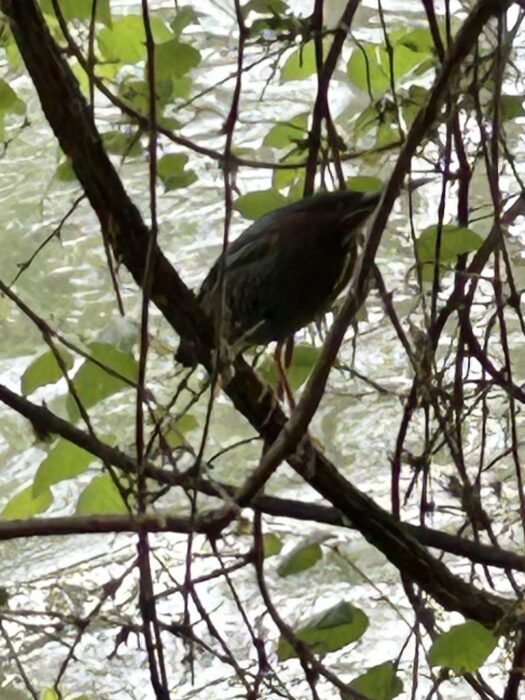
Anyway, this morning on the trail I came upon this green heron. Sorry for the photo quality — he was not interested in posing or making his presence known. Lucky for him, almost everyone walked right on by. For some reason, herons always look kind of grumpy and hunched to me. Like a grandfather on a bad day. I kind of love ‘em for it, even though it’s probably not true. (Personification has its limitations.)
May you all find the space you need today. xo
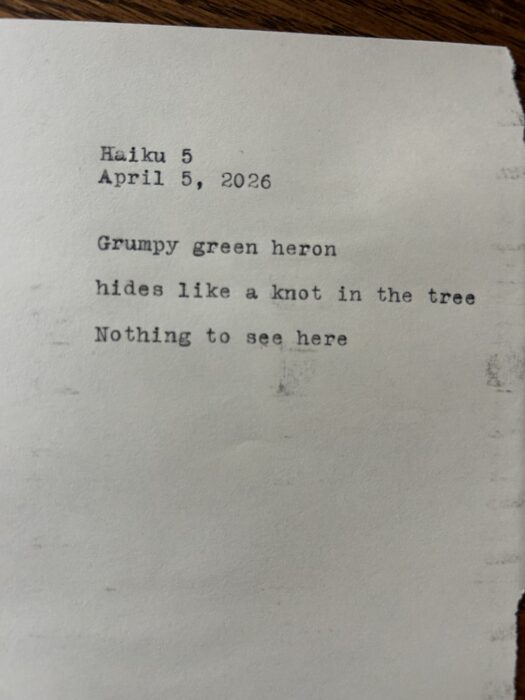
Haiku 5, 2026
Grumpy green heron
hides like a knot in the tree
Nothing to see here
These days, it can be hard to be hopeful or joyful. It can be hard to be an optimist. It can be hard to be human. There is So Much Noise. There is so much cruelty. So much, well, idiocy. So much overwhelm and upset.
But if we lose track of each other, if we lose track of all the goodness and wonder, we are truly sunk. I think haiku are one itsy bitsy way to remind ourselves not to lose track. To stay curious and even, sometimes, awe-struck. To laugh. To celebrate the occasional win. Here goes.
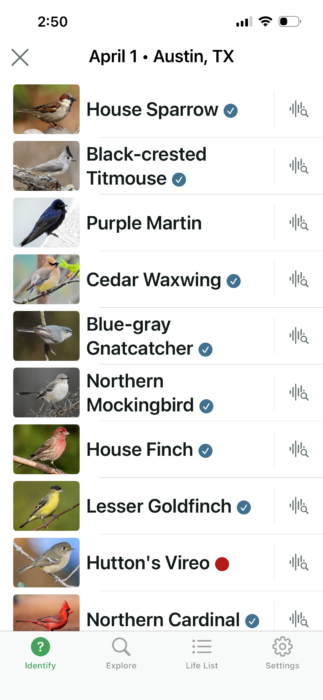
(These songs were captured the other day, but I assure you… it’s pretty well constant!)
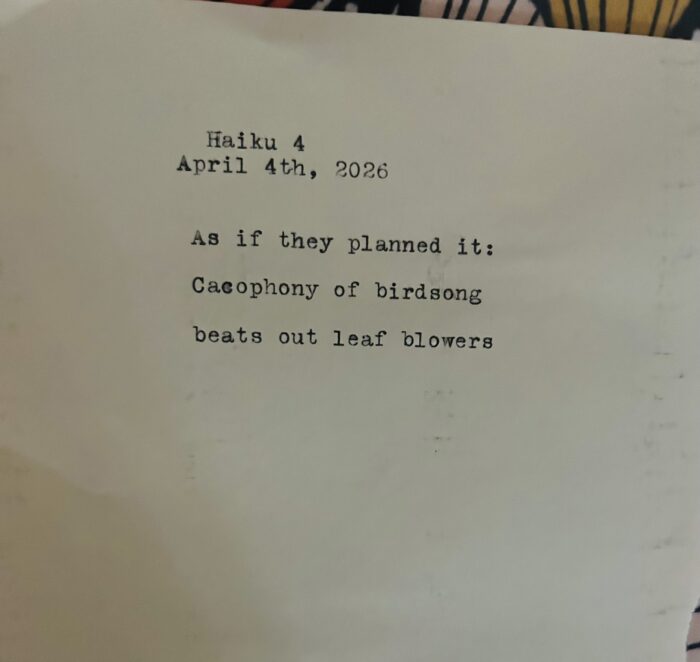
Haiku 4
As if they planned it:
Cacophony of birdsong
beats out leaf blowers
I am lucky enough to live minutes away from the perfect way to start a day. All the runners and walkers and rowers and cyclists agree. We find ourselves here, before checking the news or our work emails. We know the barrage awaits. But first, this.
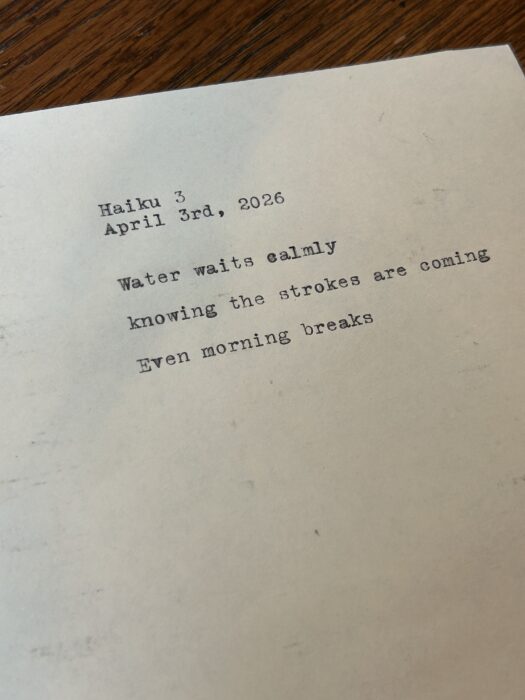
Haiku 3, 2026
Water waits calmly
knowing the strokes are coming
Even morning breaks
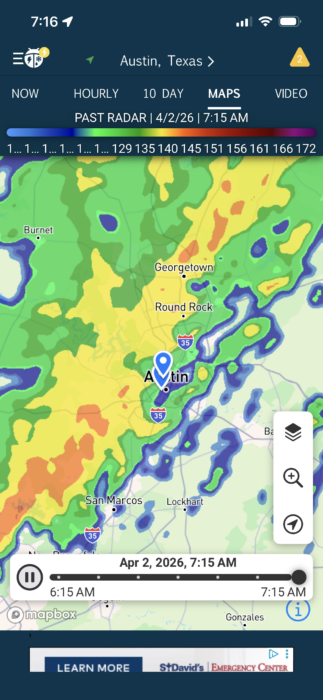
Oh, y’all. We have been in such a drought in Central Texas. Creeks that used to run, don’t. Red Flag warnings are frequent. Even the bluebonnets were a little paltry this year. And then, this morning, it rained. Like, a lot. Deep, muddy puddles in our backyard. A river rushing down the curb out front. And thunder. Big, echoey, boomy thunder.
Our beloved old dog, Keeper, used to shake himself half to death when it thundered. He was a big tough lug of a dog, and thunder turned him to absolute jelly. Now we have Poppleton. He’s goofy. Lighter. Sillier. And, in the just over six months he’s been alive, there’s been very little rain and no thunder. Until now.
He would like everyone to know: HE IS NOT A FAN.
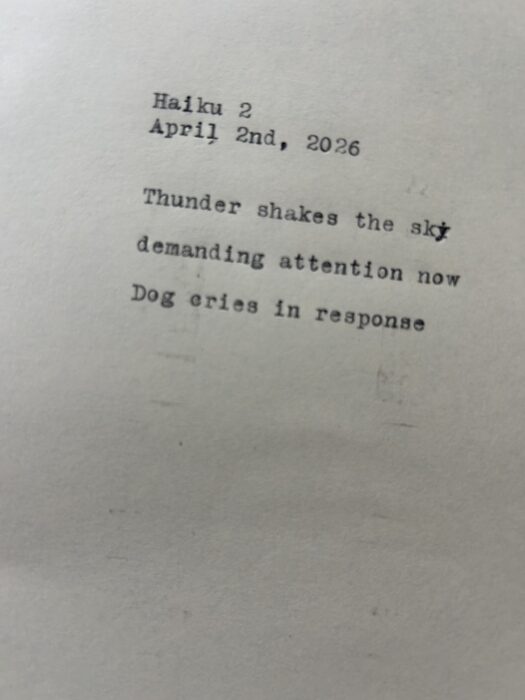
Haiku 2, 2026
Thunder shakes the sky
demanding attention now.
Dog cries in response.
Oof. It was sad over at our house this morning. But, good news: the remaining puddles are making it all worth it. Heading out again now.
PS — Put your OWN haiku in my comments!! We’d all love to see it!
In 2009, I decided to celebrate National Poetry Month by writing and sharing a haiku every day. Eighteen years later, I’m still at it. (For those of you who are math-curious, that’s already more than 8,500 syllables!)
The ritual has varied a lot over the years. Originally I shared the poems on my blog, expanding to one social media platform and then another still. Eventually I had to step away from some of those. (ahem.)
I wrote all by myself the first several years and then I invited folks to join me. Lots of you did, making the whole endeavour even more fun. Most years, I’ve written about whatever strikes my fancy but some years I chose various themes. (The year I focused on scientific processes nearly did me in. Classification, oscillation, digestion, combustion???? Liz — what???) I’ve also experimented with adding photos to the posts, to typing each poem, to sticking strictly to the Western 5-7-5 model or playing a little loose and free.
But no matter the trappings or parameters, I’m always a little happier in April (and that’s not just because it’s Aries season). There is something about haiku that is both like breath but also like a good square of chocolate. It’s a little like a prayer and a little like whistling while riding your bike. It’s good stuff. It’s a delight. It’s highly recommended. Will you join me????
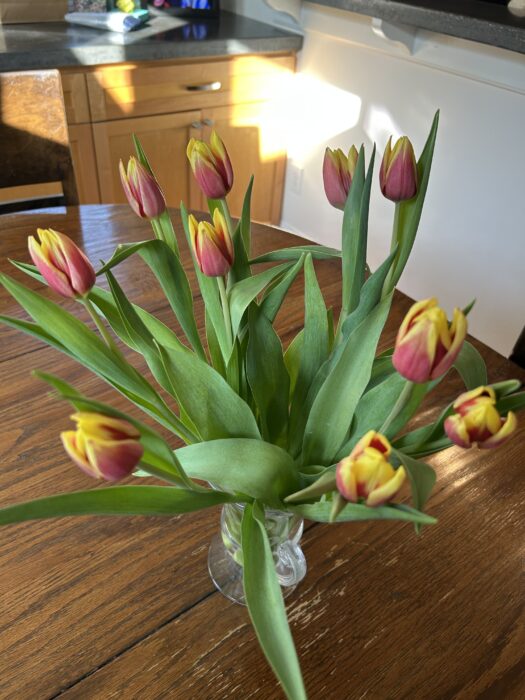
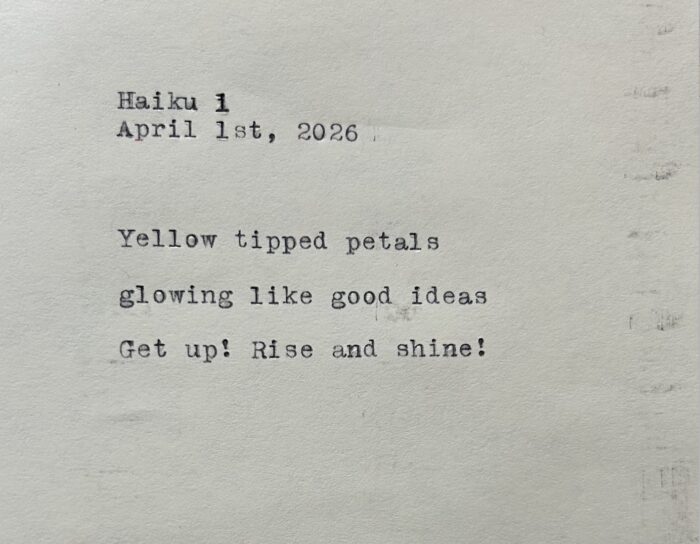
Haiku 1, 2026 Yellow-tipped petals glowing like good ideas Get up! Rise and shine!
It’s always exciting to find out about a new poetic form — and we tend (as a group) to jump in with enthusiasm when we’re planning our year full of prompts. Then, months go by and the actual work rolls around and we sit agog. What is an ovillejo? How did we get ourselves into this situation? And what do we do now?
Yep, here it is March and we welcome the ovillejo, aka the tight little bundle! Um, y’all? This is a tricky form, albeit short (three couplets and a quatrain) and — to me — it feels nearly anti-lyrical even though it rhymes! Strange, right? But a prompt is a prompt is a prompt. So. Onward.
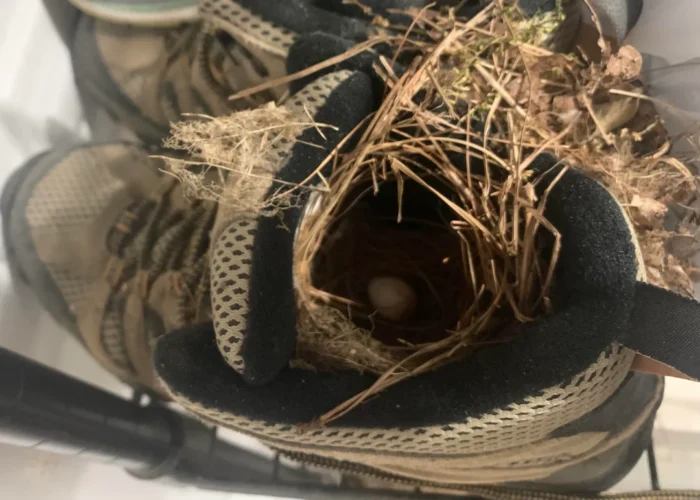
I used the tight little bundle idea as a jumping off point and ended up writing about a nest. I don’t love it, honestly, but I love that I tried it. Here goes:
My Old Boot: An Ovillejo
Liz Garton Scanlon
What is this place, so dank and mute? My old boot
Straw-filled to fit from tail to breast? A hidden nest
Bursting with sudden peeping glee? These hatchlings three!
Nothing’s quite what it seems to be The world transmutes from thread to thing from heel to home, from egg to sing! My old boot, a hidden nest, these hatchlings three …
Arthur Sze is our current — and 25th — Poet Laureate, and I couldn’t be gladder that Sara suggested we explore his work as our February prompt because I knew nothing about him, and now I do! Now, when I say “prompt,” well… this was an exceedingly loose assignment. We could take any Sze poem at all, we could mirror or echo it or be in conversation with it. We could use or not use any particular form or address any particular theme.
But Sara did share this glorious quote by Sze to get us started:“We’re not writing in competition—we’re all trying to create poems, and they’re all shining light on each other.” So, toward that end, I took the poem Downwind and played with it in two different ways.
First, I mimicked the structure of Sze’s poem. His refrain (“When the air clears after days of smoke”) made me think about what it meant to conversationally and relationally “clear the air,” so my refrain is a variation based on that idea. I also used three stanzas of seven lines each, like he did, and in the second line of each stanza I pulled from his poem the phrases “you yearn,” “you notice,” and “you believe.”
Downwind II
After Arthur Sze
By Liz Garton Scanlon
When the air clears after days of silence, you yearn to say everything at once, you open your mouth and let words pool around your feet like leaves or a loosened robe – tender, forgiving, shot from the same canon as the silence but landing, from this distance, with much less force.
When the air clears after days of silence, you notice it still has a little heat to it, the sulfurous specter hovering under and around the conversation like a cat, a serpentine cat that could trip you up, even as you forget what happened, who lit the fuse, how things flashed and banged.
When the air clears after days of silence, you believe words could become songs dissolving any corrosion left behind, but the inhale catches in your throat and there’s no melody waiting for you, no birdsong to mimic, so you fall silent again, for an extra measure or two.
My take two is a golden shovel poem, using Sze’s words”when the air clears after days of smoke” as my striking line. I don’t think it needs more introduction than that.
Downwind III
After Arthur Sze
By Liz Garton Scanlon
The child learns the difference between a question (who, what, when),
a comment (oh, wow, whoa), and a connection (this is almost like the…)
Meanwhile, every emotion in the world hangs in the air ignored, like October’s skeletal leaves. The teacher clears his throat and his eyes well up, but he says nothing after that, not a thing through his lips for days and days even though the child has a question (is this me, am I of this?) and a comment, too: I feel as see-through as smoke.
I hope you’ll have a look at what my pals have done, and also check out some more of Sze’s work yourselves. Sara Tanita Tricia Mary Lee Laura
Margaret Simon is hosting Poetry Friday this week (thank you, Margaret!) and, if you’d like to write with us next month, we’re going to be writing Ovillejos! Wheeee!
I’ve always had mixed feelings about January being “the new year.” Partly because my head and heart seem to be forever on an academic calendar and September feels fresh and full of possibility to me, but also because January is often particularly dark and cold and locked up, and so many folks are wrung out and a little sick. Not exactly full of inspiration.
Still, I gave it my all. We plunged into Barton Springs on New Year’s Day. I hung a gorgeous new calendar. I even wrote a poem befitting the occasion. (Our prompt this month, by the way, was to write TRICUBES, this funny little form made up of three stanzas, three lines in each stanza, and three syllables in each line.)
So, back to it being January. Here was my first go:
JANUARY BY THREES
Liz Garton Scanlon
my heart beats underground just waiting
for some sign promising warmth and light
this old hope beginning its spring thaw
But it turns out this form is particularly addictive and fun to play with, so even though I’m a grinch about January in general, I was able to find some enthusiasm for tricubes. What about trying to write one using just a single word per line? I thought. Like this:
PARADISE FOUND
Liz Garton Scanlon
Intimate Beloved Wilderness:
Curious Mystery, Generous
Origin, Sensitive Paradise
And then, y’all, the truth of the human world just felt too big, too dark, too terrible and important to ignore. I can’t say I understand how or why the things that are happening are happening — I honestly don’t know how the people perpetuating violence and creating chaos and speaking in tongues of rage can sleep at night — but I do know that it is our job to witness and to raise our voices whenever and wherever we can.
OUR JOB
Liz Garton Scanlon
Chronicle Everything Important
Everything Inhumane Destructive
As Gasoline, Everything That matters
I wrote a few others, but sharing three feels right considering the rules of the form. Here’s where you can go to see what everyone else did with it: Tricia Tanita Sara Mary Lee
Laura
Meanwhile, I truly do wish you all a new year full of more health, more peace, more goodness and more light. And, always, more poems.
Oh, PS — next month we’ll be getting to know the work of U.S. Poet Laureate Arthur Sze and writing in conversation with one of his works. We’d love if you’d join us — we’ll be sharing the last Friday of the month.
I couldn’t be more grateful to be closing out the year with poetry — and people who love poetry. Our theme this month was light, hope and peace (written in any form). This one doesn’t really fall into our larger 2025 theme of conversation, except that it is me in conversation with my childhood. So. Let’s go with that. Truly wishing you all more light, hope and peace in the new year. More and more…
Stringing Popcorn Liz Garton Scanlon
There was the year my sister and I strung popcorn – needle and thread pushing through our little fingers like pricks of light, half the cloud-like kernels crumbling into our flannel-nightied laps like Christmas snow.
(The Kingston Trio spun circles around us, skipping on our favorite song. Great deep drifts pushed up against the picture window.)
At bedtime, we stretched out what we had – these miniature garlands – and left them on the kitchen counter, to surprise our parents (to delight them!), but the dogs got every crumbly bit “before Mom and Dad even made it home.
The next morning, I squeezed the tender, needled pad of my finger till it hurt, till I could be sure the snowy chains had existed at all. To be sure we’d made them.
Our prompt this month was to write a poem based on something overheard (as inspired by Susan Thomsen at Chicken Spaghetti). (And yay — as a bonus, it automatically fulfills our larger goal of writing about or in conversation, since we are responding to/jumping off of other people’s thoughts and words.) I almost let this one go, in between a whirlwind trip to NCTE, family stuff, and holiday whatnot. So what you’re getting is an early-morning first draft. Some months are like that…
Overheard
Liz Garton Scanlon
I heard a woman say, my heart about fell out, and I could tell she meant
it as a good thing – good, but sad –
a way to make sense of the stuff that’s fleeting,
that knocks you sideways with beauty
and tenderness and keen, astounding pain,
the stuff that catches in your throat
with a thrum.
I think of waking from a dream about my grandmother,
a dream so real, I could feel the raised veins of her hands
as she pressed a coin into my palm.
And that drive we took to the ocean,
back when we were still new to each other,
when we were out of our minds in love and I wanted
(so desperately) to put my feet in the frothy spray
that I flew from the car and left my door wide open,
left you, just standing there.
And what about the skin of a birch tree
or those first achey notes from a cello
or turning the corner at the Uffizi and seeing The Birth of Venus, radiant and alive,
and not knowing what to say?
My heart about fell out is right,
as my children come and go again,
as light falls too early in winter, as I sit here
with this candle burning down.
My heart. My heart.
If you want to join us next month, to close out another year of poems, we’ll be writing about the light, hope and peace. Because we all need more of all of that. Until then, be well, friends. I’m so grateful for all of you.