
It’s always exciting to find out about a new poetic form — and we tend (as a group) to jump in with enthusiasm when we’re planning our year full of prompts. Then, months go by and the actual work rolls around and we sit agog. What is an ovillejo? How did we get ourselves into this situation? And what do we do now?
Yep, here it is March and we welcome the ovillejo, aka the tight little bundle! Um, y’all? This is a tricky form, albeit short (three couplets and a quatrain) and — to me — it feels nearly anti-lyrical even though it rhymes! Strange, right? But a prompt is a prompt is a prompt. So. Onward.
I used the tight little bundle idea as a jumping off point and ended up writing about a nest. I don’t love it, honestly, but I love that I tried it. Here goes:
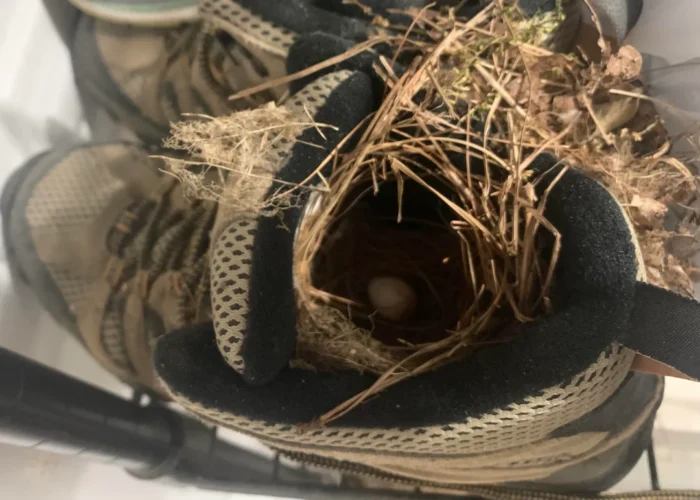
My Old Boot: An Ovillejo
Liz Garton Scanlon
What is this place, so dank and mute?
My old boot
Straw-filled to fit from tail to breast?
A hidden nest
Bursting with sudden peeping glee?
These hatchlings three!
Nothing’s quite what it seems to be
The world transmutes from thread to thing
from heel to home, from egg to sing!
My old boot, a hidden nest, these hatchlings three …
Read the other ovillejos here:
Laura
Sara
Mary Lee
Tanita
Tricia
And Marcie Atkins is our host for Poetry Friday today — thanks, Marcie!
Awww…this is a lovely Easter poem, from heel to home!
P.S. I feel like that opening question “what is this place….” could be the opening phrase for a repeated exploration of surprising things in nature (or elsewhere) in a picture book. Just saying…
ooooo an idea!
Liz, lovely! My favorite phrase: from egg to sing. : )
thanks 🙂
From egg to sing…sings! I know just how you feel about loving the attempt even if it doesn’t yield what I was hoping for. Lovely!
some poems are just like that, right?
This is so sweet. From heel to home, from egg to sing – from an old boot to a beautiful, home-shaped thing. Transformation seems to be such a good use of this ovillejo form and despite sharing some of your uncomfortable feelings about the jaggedness of the edges one can’t quite sand away, I think you nailed it, and could play well with this again. Brava.
thanks, pal… I think it was fun to try but I think I prefer the forms that really flow???
A nestled ovillejos indeed, though I couldn’t help but hold onto these lines and think about all that’s hitting us daily,
“Nothing’s quite what it seems to be
The world transmutes from thread to thing”
But you turn and leave us on a positive note, a richly woven poem, and… do I spy an egg in that old shoe…thanks Liz!
Oh, man… you’re not kidding…
I am not alone in my love for this: “from heel to home, from egg to sing!”
I guess I need to try it again and attend to the Q/A rule!
Well, I TOTALLY ignored the trochaic tetrameter rule so you’re in good company!
Your transformations are lovely – from thread to thing, from heel to home, from egg to sing! I’m in awe your poem.
Awww thanks 🙂
This is beautiful!!! I’m so impressed with what you did with this tricky form!
Thanks, Marcie — and thanks for rounding us all up today.
Ack, I’m having trouble commenting. We’ll see if I can remember what I said a second ago. 🙂
I love “from heel to home, from egg to sing!” and it made me smile (and want to sing.) 😀 I always love reading about how each of you Poetry Pals meet up, plan, discuss, and look forward to your year’s worth of challenges, and then when they roll around … well, it’s fun to read about those reactions too. 🙂
And I agree with Sara — “What is this place?” could lead you down some lovely paths!
YES — something has happened to commenting lately! I’ve lost loads of comments too! Weird!! Thanks for the sweet thoughts, though, Karen.
“from heel to home, from egg to sing” — the words delight me.
(Also just wondering how long those ol’ boots were sitting there…. lol)
Heee heee — the most recent one was built in my husband’s bike bag
Liz, your poem is not only sweet, but it is alive with movement. Your tight little bundle has received many lovely remarks from PF friends and made me smile after many rereads. Following the format has brought many different ideas on how to process the poem. Although, I too, stumbled along the way, I felt proud to complete the task. From “What is this place, so dank and mute?” to “from heel to home, from egg to sing!”, you shared you shared lovely thoughts with us.
Completing the task is sometimes enough!!
“from heel to home, from egg to sing!” Thank you for this loveliness!
“The world transmutes from thread to thing
from heel to home, from egg to sing!” – echoing all the snaps and bow-downs. What a beautiful thing to write about! And clever mama bird to choose such a spot for a home. ;0)
Liz, Love the quatrain at the end where you pull it all together. And, as always, I love the nature-inspired poetry. Thank you!
I am so liking everyone’s introductions to what they thought & felt before & in the writing of these new forms, yours included, Liz. When I read that original, it seems much like a rant, but various people have done, well, various things. You’ve told a sweet story, of a find in nature – love “Bursting with sudden peeping glee?”!
Ah, nice, Liz. Love “from egg to sing.” What an interesting form, the ovillejo.
I adore this poem, especially these lines:
The world transmutes from thread to thing
from heel to home, from egg to sing!
What a lovely celebration of life and spring.
Liz, I loved your sweet introduction about your ovillejo. I enjoyed reading your attempt, and unlike you, I love it. And the boot picture with the nest and egg showing. Wow. So glad you wrote a poem about that experience of your old boot with a hidden nest and the hatchlings three. Perfect final ending, and this: “from egg to sing!” Glorious!
I adore this poem, which so perfectly captures the photo image. Oh, sweet egg, I hope you hatched and felt safe within those canvas walls. This line was fabulous, and so fun to read! Well done.
The world transmutes from thread to thing
from heel to home, from egg to sing!
Oh, that sudden peeping glee! And the All the World feels of the quatrain. There’s a boatload–no, a bootload–of loveliness in this draft, Liz. <3